Sign Up
AI CGI Ads: Free Tools and Workflow for CGI-Style Commercials [2026]
Author:
Narek Ghazaryan
Date:
May 10, 2026
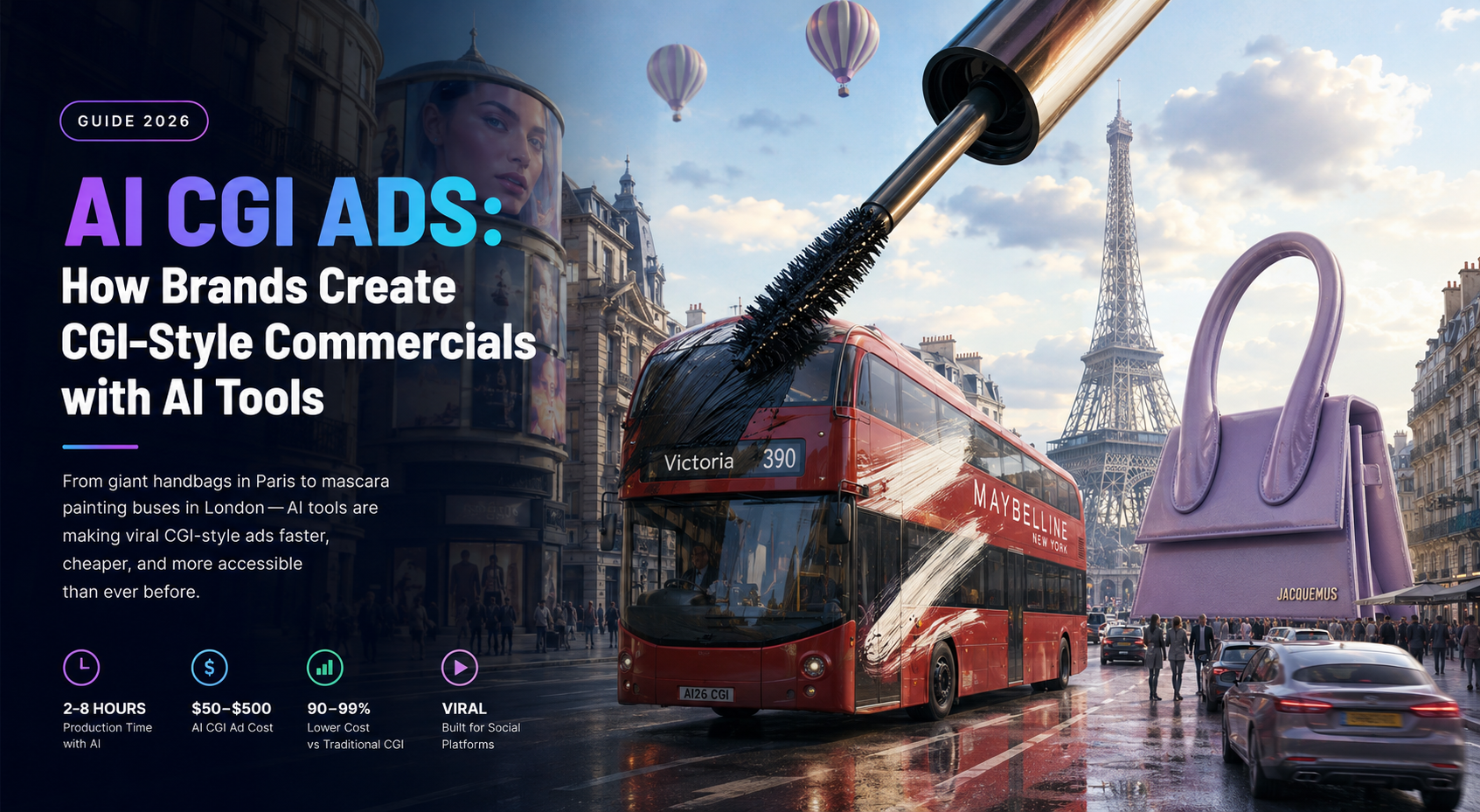
A mascara wand painting a London bus. A giant handbag rolling through Paris streets. A sneaker assembling itself 40 stories above Manhattan. These viral moments launched a new ad format. Brands spent $50,000 to $200,000 per clip to create them with traditional CGI studios. In 2026, AI tools produce the same cgi style ads ai for under $500.
AI CGI ads combine image generation with motion tools to create 3D product visuals. No 3D artists. No render farms. No weeks of production time. This guide covers the full workflow and the best tools. It also breaks down what separates high-performing ai cgi ads from forgettable ones.
What Are CGI-Style Ads?
CGI-style ads place products in surreal or hyperrealistic 3D environments. A perfume bottle towers over a cityscape. A soda can rolls through a desert. The format blends the impossible with the photorealistic.
Jacquemus popularized the style in 2023 with giant Bambino bags cruising Paris boulevards. Maybelline followed with mascara brushes sweeping across subway cars. Both campaigns earned millions of organic views and set a new standard for product advertising.
The AI in advertising market reached $4.1 billion in 2025 with a 28.4% CAGR projected through 2032 (source: Verified Market Research). Much of that growth flows into AI-generated visual ad formats, including ai cgi ads.
Why Do CGI-Style Ads Work?
The format works because it breaks visual expectations. Audiences scroll past standard product photography. A building-sized lipstick stops them. Psychologists call this a "pattern interrupt." The brain notices what does not belong.
Instant attention: The surreal scale forces viewers to pause and process what they are seeing.
High shareability: People share content that surprises them. Impossible visuals trigger that response consistently.
Brand recall: Oversized products in real environments create memorable associations between the brand and the visual.
Platform fit: Short, looping CGI clips match the format that Instagram Reels and TikTok algorithms reward with reach.
How to Create AI CGI Ads in 5 Steps
The ai cgi ads workflow replaces months of 3D production with five stages that run in hours.
1. Define the concept with a storyboard: Every effective ad starts with a visual plan. What product? What environment? What camera angle? Sketch or generate storyboard panels before touching any AI tool. Script to storyboard AI converts written scene descriptions into visual panels that guide the entire production.
2. Generate the base product image: Upload a clean product photo. An ai cgi generator places it into a photorealistic 3D scene with cinematic lighting, depth, and environmental context. Freepik AI Suite, Leonardo AI, and Midjourney handle this stage.
3. Refine the scene: Adjust composition, fix lighting mismatches, and expand backgrounds. Most ai cgi tools include inpainting and outpainting. These features let you fix specific areas without regenerating the entire image.
4. Animate: Convert the static image into video. Runway, Kling, and Pika add camera sweeps, product motion, and environmental effects. A still product shot becomes a cinematic ai ad video in minutes.
5. Add post-production polish: Layer sound design, music, brand elements, and text overlays. This final stage uses standard editing software. The output is a finished ad ready for Instagram, TikTok, or YouTube.
Previsualisation workflows help you test compositions and camera angles before committing to full generation. Catching framing issues at the storyboard stage saves hours of rework.
Best Free and Paid Tools for AI CGI Ads
Choosing the right tools depends on budget and which stage of the pipeline needs the most control. Several are free ai tools for creating cgi style ads with commercial potential.
Brands testing the format can run the entire workflow on free tiers from Freepik, Leonardo, and Kling. Free output includes watermarks or lower resolution. Paid plans remove these limits and unlock commercial licensing.
AI filmmaking tools in 2026 covers additional tools for video production beyond advertising use cases.
How Much Do AI CGI Ads Cost vs Traditional CGI?
Cost is the primary reason brands switch from traditional CGI to AI-generated alternatives.
A single traditional CGI product ad runs $10,000 to $100,000. That covers 3D modeling, texturing, lighting, rendering, and compositing. A team of five to twenty specialists works two to six weeks.
A comparable ai cgi ad costs $50 to $500 with AI tools. One to three people handle the full pipeline in one to three days. That 90 to 99 percent cost reduction opens the format to startups and independent brands. These teams could never afford traditional CGI.
The tradeoff is control. Traditional CGI offers millimeter precision. AI generation offers speed and volume. For social media advertising, where content lifespan is measured in days, speed usually wins.
What Makes AI CGI Ads Go Viral?
Not every ai cgi ad earns views. The clips that break through share five traits.
Impossible scale: The product appears impossibly large against a real-world backdrop. A lipstick tube the height of a skyscraper. A watch face filling Times Square. Scale mismatch triggers immediate curiosity.
Believable lighting: Shadows, reflections, and ambient light must match the real environment. If the CGI product looks pasted onto the background, the illusion breaks. AI tools trained on photographic data handle this well.
Cinematic motion: Static shots feel like images, not ads. Slow camera sweeps and parallax effects create the cinematic quality that separates scroll-stopping content from skippable posts. Film composition principles guide these camera decisions at the storyboard stage.
Three to eight second runtime: Short enough to loop. Long enough to register the product. Social algorithms reward high replay rates. Tight duration drives both.
Product clarity: Surreal settings attract attention. But the product must stay centered and recognizable. The best cgi style ads ai never let the environment overshadow the product.
Mistakes That Kill AI CGI Ad Performance
Skipping the storyboard: AI generation is fast. That speed tempts creators to jump straight into image generation without a plan. The result is visually impressive clips that serve no campaign goal. A storyboard forces intentional shot choices before production begins.
How filmmakers create storyboards with AI covers how to build visual plans quickly using AI tools.
Inconsistent product look: When generating multiple ad variations, the product can shift in color, proportion, or detail between clips. This confuses audiences and dilutes brand trust.
Best AI storyboard generators maintain product and character consistency across dozens of panels for exactly this reason.
Overcomplicating the scene: The strongest ai cgi ads use one product, one environment, and one camera movement. Adding multiple elements splits attention and weakens the visual punch.
Ignoring platform specs: A landscape ad built for YouTube fails on TikTok. A 16-second clip underperforms against a looping 6-second version on Instagram Reels. Video production with storyboarding covers format planning across platforms and aspect ratios.
Frequently Asked Questions
What is an AI CGI ad?
An AI CGI ad is a product commercial created with AI image generation and animation tools. It replicates the look of traditional computer-generated imagery without requiring 3D modeling software, render farms, or specialized CGI artists. Brands use ai cgi ads for social media, e-commerce, and digital campaigns.
Can I create CGI-style ads for free?
Yes. Free tiers from Freepik AI, Leonardo AI, Kling, and Pika cover the full workflow. You can generate product images, animate them into video, and export clips at no cost. Free plans limit resolution, add watermarks, or cap daily usage. They work for testing concepts before committing to paid production.
How long does it take to make an AI CGI ad?
A single ai cgi ad takes two to eight hours from concept to finished video using AI tools. Traditional CGI production for the same concept takes two to six weeks. The speed difference lets brands produce dozens of ad variations in the time traditional CGI delivers one.
Plan Before You Generate
AI cgi ads work best when every shot serves a clear purpose. The storyboard stage is where campaigns are won or lost. Strong visual planning prevents wasted generation cycles and keeps the product message sharp.
DrawStory builds storyboards that feed directly into AI ad production pipelines. AI storyboarding built for campaigns that need consistent product visuals across multiple ad variations and social platforms.
Frequently Asked Questions
Got Questions?
Find clear answers to common questions about Drawstory, our services, process, and how we bring your ideas to life.
What exactly is an AI CGI ad?


Do AI CGI ads really replace traditional CGI production?
Can I create AI CGI ads without any design experience?
How long does it take to produce one AI CGI ad?
Why do AI CGI ads perform well on social media?



